

Table of Contents
- What You'll Need Before You Start
- Step 1: Check for the NASC Quality Seal Requirements
- Step 2: How to Read Pet Supplement Labels Like a Pro
- Step 3: Confirm Third-Party Testing for Pet Supplements
- Step 4: Interpret a Certificate of Analysis
- Step 5: Verify Ingredient Sourcing Transparency
- Step 6: Assess Stability and Shelf-Life Testing
- Step 7: Check for Supplement-Drug Interaction Risks
- Frequently Asked Questions
Last Updated: September 13, 2026
What You'll Need Before You Start
Verifying pet supplement quality means confirming a product contains what its label claims, in the stated amounts, without harmful contaminants. It takes a laptop, the packaging, and about 20 minutes per supplement.
Gather these items before you begin:
- The supplement bottle or bag, including the lot number on the bottom
- The manufacturer's website open in a browser
- A notepad for tracking which products pass and which raise questions
- Your pet's current medication list, if they take any
At Paw and Pestle, we built our catalog around this verification work. Below are seven steps that let you run the same checks a veterinarian does.
Step 1: Check for the NASC Quality Seal Requirements
The NASC Quality Seal is awarded by the National Animal Supplement Council to manufacturers meeting its facility and labeling standards. To carry it, a company must pass an independent facility audit, follow strict labeling rules, and report adverse events.
Look for the seal on the package itself, not just the website. A seal that appears only in marketing materials, with no matching logo on the physical label, is a warning sign.
The NASC Quality Seal requirements cover four main areas:
- Independent third-party facility audits on a regular schedule
- Label claims reviewed against actual product contents
- A formal adverse event reporting system
- Raw ingredient sourcing controls and documentation
Products like Laxatone Hairball Laxative Oral Gel for Cats carry the NASC seal, meaning the manufacturer has opened its facility to outside auditors. Not every legitimate product carries it, but no certification plus a refusal to share testing documents should end your evaluation.

Step 2: How to Read Pet Supplement Labels Like a Pro
Reading a pet supplement label means separating the guaranteed analysis from the marketing. The guaranteed analysis lists minimum or maximum amounts of key nutrients and is the only part of the label with legal weight.
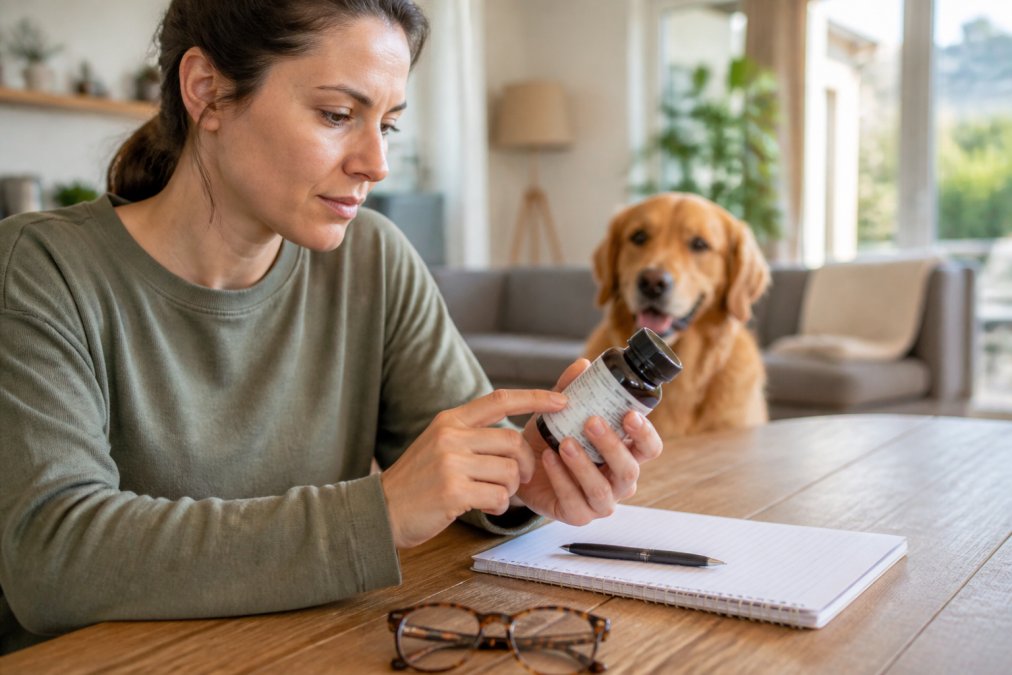
Check these elements in order:
- Active ingredients with amounts per serving, not just names
- Inactive ingredients listed individually, not hidden under "proprietary blend"
- Serving size matched to your pet's weight
- Manufacturer name and address, not just a distributor
- Lot number and expiration date printed clearly
A "proprietary blend" lets a company list ingredients without amounts, making potency impossible to verify. If a joint supplement hides its glucosamine level behind a blend, you cannot confirm a therapeutic dose.
Step 3: Confirm Third-Party Testing for Pet Supplements
Third-party testing for pet supplements means an independent laboratory, not the manufacturer, analyzes the finished product for potency, purity, and contaminants. A lab owned by the same company that makes the product does not count.
Ask the manufacturer two direct questions. Which laboratory performs your testing, and can you send me a recent report? Companies that test properly answer both without hesitation.
Look for these test categories in any report you receive:
- Potency verification against label claims
- Heavy metal testing for lead, arsenic, mercury, and cadmium
- Microbial analysis for salmonella and E. coli
- Chemical contaminant screening
The [FDA's guidance on animal supplements | fda.gov] explains that these products fall outside standard drug approval, placing the testing burden on manufacturers and, in practice, on you. Asking for documents is the only way to know.
Step 4: Interpret a Certificate of Analysis
A Certificate of Analysis (COA) is a testing laboratory document reporting the actual measured contents of a specific batch. It is the most valuable document in supplement verification, and learning to read it takes about ten minutes.
The five fields that matter
Read a COA in this order, and stop if any of the first three do not match your bottle:
- Product name and lot number, must match your bottle exactly, character for character. A COA for a different lot tells you nothing about your product.
- Testing laboratory name, a lab you can look up independently. If the "lab" shares an address or parent company with the manufacturer, it is not truly third-party.
- Test date and report date, within the last year for the current batch, and ideally within the last six months for probiotics or oils.
- Measured results versus label claim, the actual number the lab found, expressed in the same units as the label (mg, CFU, IU, mcg).
- Contaminant results with thresholds, heavy metals, microbes, and solvents reported against a stated limit, not just a checkmark.
How to read the measured values
A COA does not just say "pass", it reports a number, and that number tells you how honest the label is.
- Potency within range. If the label claims 500 mg of glucosamine per serving and the COA reports 480 mg, that is a normal manufacturing variance and a good sign. If it reports 250 mg, the product is underdosed by half.
- Overages are a yellow flag. Some manufacturers deliberately overage ingredients so the product still hits label claim at expiry. A COA showing 700 mg against a 500 mg claim may reflect intentional overage, ask why.
- Units matter. Probiotics are measured in CFU (colony-forming units), often in billions. A COA reporting "1.2 x 10^9 CFU" is 1.2 billion CFU, not 1.2 million. Misreading the exponent is the single most common owner error.
- Detection limits. A heavy metals result of "< 0.5 ppm lead" means the lab could not detect lead above 0.5 parts per million, different from "0 ppm." A lab that can detect down to 0.1 ppm gives you a more meaningful result than one capped at 1 ppm.
- "Pass" with no number. A COA that lists only "pass" or "conforms" with no measured value tells you almost nothing. Push back and ask for the raw data.
What a strong COA looks like
A strong COA names the lab, lists the lot, reports measured values in the same units as the label, includes contaminant results with numeric thresholds, and is signed or stamped by the testing lab, not the manufacturer.
A veterinarian or veterinary nutritionist can review a COA with you, a reasonable use of a routine visit, and far cheaper than discovering months later that a joint supplement never contained the dose it claimed.
Step 5: Verify Ingredient Sourcing Transparency
Ingredient sourcing transparency means the manufacturer discloses where its raw materials come from and how they are handled before production. Contamination usually enters through raw ingredients, not the manufacturing line: finished-product testing catches a contaminated batch, but sourcing controls prevent it.
The useful question is not where ingredients come from but how the manufacturer verifies what it receives, and whether that verification is documented.
Why sourcing region matters
Raw ingredients for pet supplements come from a global supply chain. The practical differences owners should understand:
- Domestic sourcing generally means ingredients produced under U.S. oversight, with traceable records and shorter shipping times. It does not guarantee higher quality, but the manufacturer has more direct recourse if something goes wrong.
- International sourcing is not inherently worse, many high-quality ingredients originate overseas. The risk is that oversight varies by country, and a manufacturer buying on price alone may not audit suppliers.
- Single-source versus multi-source. A company buying the same ingredient from multiple suppliers to manage price will have more variable quality than one locked into a single audited source.
The four questions that expose vague sourcing
- "Can you name the supplier or at least the country and region of origin for each active ingredient?" A company that can answer this has done the work. "We source globally from trusted partners" is not an answer.
- "Do you audit suppliers in person, or do you rely on their certificates?" In-person audits are expensive and rare. A company that does them will say so.
- "Do you test incoming raw materials, or only the finished product?" Raw-material testing catches problems before they are blended into a batch. Finished-product testing catches them after. Both matter, but raw-material testing is the earlier and cheaper control.
- "What happens when a supplier fails an audit?" A documented supplier-approval and disqualification process is a sign of a real quality system.
What transparency actually looks like on a label
Products such as Entero Flora PRO Powder for Cats and Dogs list probiotic strains and prebiotic components individually, letting you trace what your pet actually receives. That is the standard to hold other products to.

A label naming specific strains (for example, Lactobacillus acidophilus and Bifidobacterium animalis) is more transparent than one that says "probiotic blend." Naming a chelated mineral form ("glucosamine hydrochloride" versus "glucosamine sulfate") shows the manufacturer chose a specific, testable input rather than a commodity.
Vague sourcing language like "premium ingredients," "pharmaceutical grade," or "human-grade" without specifics is a gap, not a feature. None has a legal definition in the supplement market, and a company leaning on them instead of naming suppliers is telling you where its effort went.
Step 6: Assess Stability and Shelf-Life Testing
Stability testing confirms a supplement still delivers its labeled potency at the end of its shelf life, not just on the day it was made. Many products pass release testing and then degrade in storage.
Ask whether the manufacturer runs accelerated stability studies or real-time shelf-life testing. Probiotics and fatty-acid products are especially vulnerable to potency loss over time.
Three practical checks:
- Does the expiration date reflect stability data or an arbitrary period?
- Are storage instructions specific, such as a temperature range?
- Does the packaging protect against light and moisture?
A product with a two-year expiration date and no stability documentation behind it is making a claim it cannot support.
Step 7: Check for Supplement-Drug Interaction Risks
Supplement-drug interaction risks are real and under-discussed. Certain ingredients can amplify or reduce the effect of prescription medications, and the risk grows for senior pets on multiple drugs.
If your pet takes medication for heart, kidney, thyroid, or seizure conditions, review every new supplement with your veterinarian first. Bring the actual label, not a description.
Watch these categories closely:
- Herbal ingredients that affect blood clotting
- Calcium or mineral supplements that interfere with certain antibiotics
- Ingredients processed by the liver or kidneys, which matters for pets with organ issues
Adverse event reporting systems exist for a reason: when a product causes a reaction, manufacturers and regulators need to know. Paw and Pestle was founded by Dr. Elena Shockman, VMD, to provide owners with access to expert-vetted products.
Verifying pet supplement quality takes patience, but the payoff is a formula you can trust for a pet you love. Paw and Pestle hand-picks every supplement in its catalog, from NASC-sealed digestive support to dental powders like TEEF for Life Protektin42 Kit, so the verification work is done before a product reaches your door. Free shipping on orders over $75 makes it easy to start with one product and see the difference. Get started with Paw and Pestle and give your pet expert-backed wellness support.

Frequently Asked Questions
How can I tell if a pet supplement is third-party tested?
Look for a Certificate of Analysis (COA) from an independent laboratory on the manufacturer's website or request it directly. The COA should list test results for potency, purity, and contaminants like heavy metals and microbes. Reputable brands often include a batch number that matches the COA. If a company cannot provide a COA for a specific product lot, treat that as a red flag and consider another option.
What does the NASC Quality Seal mean for pet supplements?
The NASC Quality Seal indicates that a product meets the National Animal Supplement Council's standards for quality and safety. To earn the seal, manufacturers must pass independent audits, follow good manufacturing practices, and report adverse events. The seal also requires proper labeling and ingredient sourcing. While not a government certification, it is a trusted industry benchmark that helps you identify products with verified oversight.
Are pet supplements regulated by the FDA?
The FDA regulates pet supplements as animal feed, not as drugs. This means they do not undergo pre-market approval for effectiveness. However, the FDA does enforce rules on labeling accuracy and good manufacturing practices. The agency can take action against unsafe or mislabeled products. Because oversight is limited, third-party testing and seals like NASC become important tools for verifying pet supplement quality.
What should I look for on a pet supplement ingredient label?
Check for a guaranteed analysis that lists the amount of each active ingredient per serving. Look for specific, standardized extracts rather than vague blends. Avoid products with unnamed fillers or artificial preservatives. The label should also include a batch number, expiration date, and contact information for the manufacturer. If the label makes bold claims without supporting data, be cautious.
0 comments