

Last Updated: November 7, 2026
Quick Summary
Natural anxiety relief supplements for cats work best when matched to a specific stress trigger and started after a vet rules out medical causes. Ingredients with the most consistent support include alpha-casozepine and L-theanine, and daily formulas such as alpha-casozepine work best started about a week ahead.
- A vet checkup with bloodwork, urinalysis, and a thyroid panel comes before any calming supplement.
- A label should list every active ingredient with a specific amount, not a proprietary blend.
- Give a daily supplement at the same time each day so you can judge the effect fairly.
- Feliway Happy Snack combines alpha-casozepine and L-tryptophan, and you should not exceed two tubes per day.
- Skip homemade remedies containing essential oils, garlic, onion, or alcohol because they are toxic to cats.
Table of Contents
- Why Natural Anxiety Relief Supplements for Cats Need a Plan, Not a Guess
- How to Spot Feline Stress and Rule Out Medical Causes First
- The Best Calming Supplements for Cats and What the Evidence Says
- Cat Anxiety Supplement Safety and Ingredients: How to Read a Label
- Dosing, Timing, and How Long Calming Supplements Take to Work
- Natural Sedative for Cats for Travel and Vet Visits
- Natural Anxiety Relief Supplements for Cats Homemade: What's Safe and What Isn't
- Choosing the Right Calming Product at Paw and Pestle
- Frequently Asked Questions
- References
- About the Author
Why Natural Anxiety Relief Supplements for Cats Need a Plan, Not a Guess
Natural anxiety relief supplements for cats can help a nervous cat settle, but only when you match the product to the trigger and rule out medical causes first. A common pattern among cat owners is a stressful vet visit or a move, then a rushed purchase, then uncertainty about whether anything changed.
The problem is rarely the supplement itself. It is the missing plan.
Below, we break down how to spot real feline stress, which ingredients have the strongest evidence, how to read a label, and how to dose and time a calming supplement so you can judge whether it works. We also cover travel and vet visits, homemade remedies worth avoiding, and how to choose a product with confidence.
How to Spot Feline Stress and Rule Out Medical Causes First
Cats hide stress well, which is why behavior changes often get missed until something else goes wrong. Watch for the quiet signals first.
Common stress triggers include travel, vet visits, new people in the home, a new pet, remodeling, and any shift in routine. Signs of anxiety in cats range from obvious to subtle:
- Hiding more than usual, or avoiding rooms and people
- Over-grooming, especially bald patches on the belly or inner legs
- House soiling and urinating outside the litter box
- Reduced appetite or eating faster than normal
- Pacing, yowling, or restlessness at night
- Flattened ears, dilated pupils, or a tucked tail during handling
Anxiety Symptoms Versus Illness: What a Vet Needs to Check
Some of these signs overlap with medical problems, so a checkup with your veterinarian comes before any supplement. A veterinarian will typically run bloodwork, a urinalysis, and a thyroid panel, and will check for pain and dental disease. Hyperthyroidism, kidney disease, and arthritis can all produce restlessness or irritability that looks like anxiety.
If your cat is older, ask specifically about cognitive dysfunction. A senior cat pacing at night may need a different plan than a young cat stressed by a new roommate.
The Best Calming Supplements for Cats and What the Evidence Says
The best calming supplements for cats are built on ingredients with real research behind them, dosed at amounts a cat can actually take, not a long list of herbs with no numbers. Evidence quality varies widely by ingredient, and that should drive your choice more than the front of the bag.
Before trusting any product, it helps to know how to verify quality and sourcing. Our guide on how to verify pet supplement quality walks through the checks that matter.
A useful way to sort ingredients is by how much is actually known about them in cats. The tiers below are a practical summary, not a ranking of products.
Tier 1: Ingredients With the Most Consistent Support
Alpha-casozepine is a peptide derived from milk protein, and it is the active ingredient in Zylkene.
What the research shows: In a controlled study of 24 fearful cats, a diet with alpha-casozepine and L-tryptophan reduced anxiety when cats were placed in an unfamiliar room, but it did not reduce fear of an unfamiliar person.1 A second study of 21 cats found the same combination lowered urinary cortisol, a stress hormone, over 8 weeks.2 Because both studies paired it with L-tryptophan, the benefit can't be credited to alpha-casozepine alone. The honest read: real but modest, and it works best for specific situations like a new environment.
L-theanine is an amino acid found in tea.
What the research shows: In a 30-day field study of 33 stressed cats given L-theanine twice daily, owners reported improvement in 91% of cats, with the biggest change in peeing outside the litter box. The study had no placebo group and was run with the manufacturer, so the true effect may be smaller.3
Tier 2: Ingredients With Mixed or Limited Feline Data
Magnolia and phellodendron extracts are plant ingredients used in some soft chews, usually paired with L-theanine.
Colostrum calming complex is a milk-derived ingredient used in some veterinary-strength formulas.
Saffron extract and probiotics appear in some formulas with limited feline data.
Thiamine (vitamin B1) supports normal nervous system function and shows up in several veterinary calming formulas, but we could not find published studies testing it on its own for stress in cats.
Tier 3: Herbs Best Treated as Enrichment, Not Treatment
Valerian root, chamomile, and catnip have far thinner evidence in cats.
Watch out: a product that lists several herbs with no amounts is not more comprehensive, it is unverifiable. One named active at a stated dose is easier to evaluate than five unnamed ones.
If you want a product built around alpha-casozepine, Vetoquinol Zylkene Calming Capsules is a single-ingredient option that can be opened and sprinkled over food.

Vetoquinol Zylkene Calming Capsules for Dogs & Cats
Cat Anxiety Supplement Safety and Ingredients: How to Read a Label
Cat anxiety supplement safety and ingredients come down to one habit: read the guaranteed analysis before you read the marketing. A label should list every active ingredient with a specific amount, not a proprietary blend.
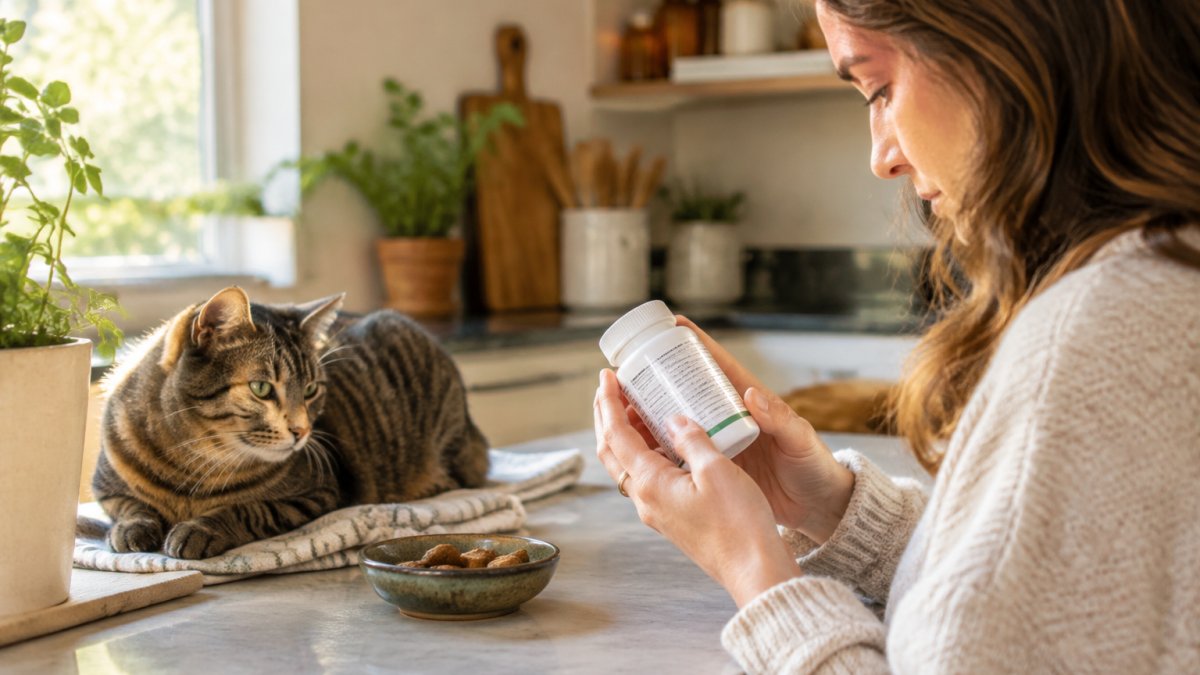
Check these five things on any calming product:
- Named actives with amounts. "Calming blend" with no numbers tells you nothing.
- A quality seal. The NASC Quality Seal indicates the product comes from a facility that has been audited.
- A stated dose by weight. Cats and dogs differ, and small cats need smaller doses.
- Sedation claims. A product that promises drowsiness is not the same as one that supports calm behavior.
- Full ingredient statement. Look for artificial colors, preservatives, and fillers you would rather skip.
Our step-by-step guide to how to read pet supplement labels breaks down each panel so you know exactly what you are buying.
When a Calming Supplement May Be Unsuitable
Some cats should not start a calming supplement without a veterinarian's sign-off.
Watch out: never give human sedatives, antihistamines, or essential oils to a cat. Cats metabolize many drugs differently than dogs, and dosing errors can cause serious harm.
Possible Interactions and Adverse Effects
Calming supplements are not inert, and the risk rises when several products are stacked. If your cat is on any medication, call your vet before adding a supplement, and bring the label with the exact amounts.
Signs that warrant stopping the product and contacting a veterinarian include vomiting, diarrhea, drooling, wobbliness, unusual lethargy, loss of appetite, or a sudden change in behavior.
Anxiety Versus a Medical Problem
Some signs that look like anxiety are medical until proven otherwise. Sudden hiding, appetite change, house soiling, night yowling, or irritability in an older cat should prompt a veterinary visit before any supplement.
A practical rule: if the behavior change came on suddenly, is paired with weight or appetite change, or involves the litter box, book the vet visit first. Supplements are for cats whose health check is clear and whose stress has an identifiable trigger.
Dosing, Timing, and How Long Calming Supplements Take to Work
Situational products can be given shortly before an event, but daily formulas such as alpha-casozepine work best started about a week ahead.
Follow the label dose by weight, and do not exceed it without veterinary guidance. If your cat is on medication or has a chronic condition, call your vet first. Timing matters too: give a daily supplement at the same time each day so you can judge the effect fairly.
Give it a realistic trial.
Natural Sedative for Cats for Travel and Vet Visits
A natural sedative for cats for travel works best as a plan built around the carrier, not a pill given in the parking lot. Start carrier training days ahead, and use a calming treat before the stressor rather than after.
For car rides and vet visits, a lickable treat is often the easiest format to get into a stressed cat. Feliway Happy Snack Calming Treat for Cats combines alpha-casozepine and L-tryptophan in a creamy tube, and it can be offered from a finger to build a positive association with the carrier. It is a complementary treat, not a complete diet, and you should not exceed two tubes per day.
For a daily capsule approach around an event, Vetoquinol Zylkene Calming Capsules for Dogs & Cats at $37.99 is designed to be started about a week before and continued through the event.
Watch out: never give human sedatives or antihistamines to a cat without veterinary direction. Dosing errors in cats can cause serious harm, and cats metabolize many drugs differently than dogs.
Natural Anxiety Relief Supplements for Cats Homemade: What's Safe and What Isn't
Homemade natural anxiety relief supplements for cats are risky because you cannot control the dose, and some common ingredients are toxic to cats. Skip anything containing essential oils, garlic, onion, or alcohol.
What you can safely do at home is enrichment, not pharmacology. Try scheduled play, puzzle feeders, vertical space, and a consistent routine. These reduce baseline stress and make any supplement more likely to help.
If you want to use a single herb, talk to your vet first. Chamomile and valerian appear in commercial formulas at controlled doses, and replicating that at home is guesswork.
Choosing the Right Calming Product at Paw and Pestle
Choosing the right calming product starts with the trigger, then the format your cat will actually accept. A cat that refuses chews needs a lickable or sprinkleable option, and a cat with ongoing stress needs a daily formula rather than a one-off dose.
Here is how we would choose:
Situation |
Format |
Product |
Price |
|---|---|---|---|
Occasional stress, hard-to-pill cat |
Lickable treat |
Feliway Happy Snack, 12 tubes |
$24.99 |
Planned event, daily support |
Capsule, sprinkleable |
Vetoquinol Zylkene, 30 ct |
$37.99 |
Daily calming, small cat |
Soft chew |
Nutramax Solliquin, 75 ct |
$19.99 |
Multi-pet household, fast-acting |
Soft chew |
VetriScience Composure Pro, 45 ct |
$55.50 |
Price
For a soft chew that covers both cats and dogs, Nutramax Solliquin Calming Soft Chews at $19.99 combines L-theanine with magnolia and phellodendron extracts. For a veterinary-strength formula with colostrum calming complex, L-theanine, and thiamine, VetriScience Composure Pro Advanced Calming Soft Chews at $55.50 is NASC Quality Certified and made in an SQF-certified facility.


Every product on our shelf is hand-picked by Dr. Elena Shockman, VMD, and free shipping applies on orders over $49. If you are unsure which fits your cat, our supplement consultation with Dr. Shockman can help you decide before you order.
A stressed cat is not a behavior problem to suppress; it is a signal that needs a plan. Start with a vet check, pick one supplement with a named active and a clear dose, and give it a fair trial.
Frequently Asked Questions
What can I give my cat for anxiety naturally?
Start with ingredients that have the most veterinary use behind them: alpha-casozepine (a milk protein peptide), L-theanine, and thiamine. Paw and Pestle carries several options built around these, including VetriScience Composure Pro Advanced chews at $55.50 and Nutramax Solliquin soft chews at $19.99. Pair any supplement with environmental fixes like a quiet room, vertical space, and a consistent routine. Skip essential oils and human herbal blends, which can be toxic to cats.
Are natural calming supplements safe for cats?
Quality matters more than the word natural. Look for the NASC Quality Seal, a named manufacturer, and a full ingredient list with amounts. Cat anxiety supplement safety and ingredients go together: a product with vague proprietary blends tells you nothing about dose. Avoid anything containing xylitol, garlic, onion, or caffeine. If your cat has kidney disease, liver disease, or takes prescription medication, get veterinary clearance before starting anything new.
How long do calming supplements take to work in cats?
It depends on the ingredient. Zylkene ($37.99) is designed to be given daily over a stretch of days rather than as a single dose. VetriScience Composure Pro Advanced chews can be given up to two times daily or as needed, and it is safe to double the amount in times of increased stress, per the product directions.
Can I give my cat human anxiety supplements or herbs?
No, not without veterinary guidance. Doses formulated for people are far too high for a cat, and several common herbal ingredients, including some essential oils and certain plant extracts, are toxic to felines. Even cat-safe herbs like valerian and chamomile need the right dose and form. If you want to try a natural sedative for cats for travel, use a product made and dosed for cats, and confirm timing with your vet before the trip.
References
- Landsberg G, Milgram B, Mougeot I, Kelly S, de Rivera C. Therapeutic effects of an alpha-casozepine and L-tryptophan supplemented diet on fear and anxiety in the cat. Journal of Feline Medicine and Surgery. 2017;19(6):594–602. https://doi.org/10.1177/1098612X16669399
- Miyaji K, Kato M, Ohtani N, Ohta M. Experimental verification of the effects on normal domestic cats by feeding prescription diet for decreasing stress. Journal of Applied Animal Welfare Science. 2015;18(4):355–362. https://doi.org/10.1080/10888705.2015.1005301
- Dramard V, Kern L, Hofmans J, et al. Effect of l-theanine tablets in reducing stress-related emotional signs in cats: an open-label field study. Irish Veterinary Journal. 2018;71:21. https://doi.org/10.1186/s13620-018-0130-4
About the Author
Dr. Elena Shockman, VMD is a veterinarian with 16 years in practice, first in general practice and then in emergency and critical care. She earned her VMD from the University of Pennsylvania School of Veterinary Medicine and is the founder of Paw & Pestle, a vet-curated supplement marketplace. As an integrative veterinarian, she looks at the evidence first and is honest about what the science does and doesn't show. Her mission is to help keep pets out of the ER with reliable pet health information.

0 comments